
The NWT's power demands are about to surge. Is the grid ready?
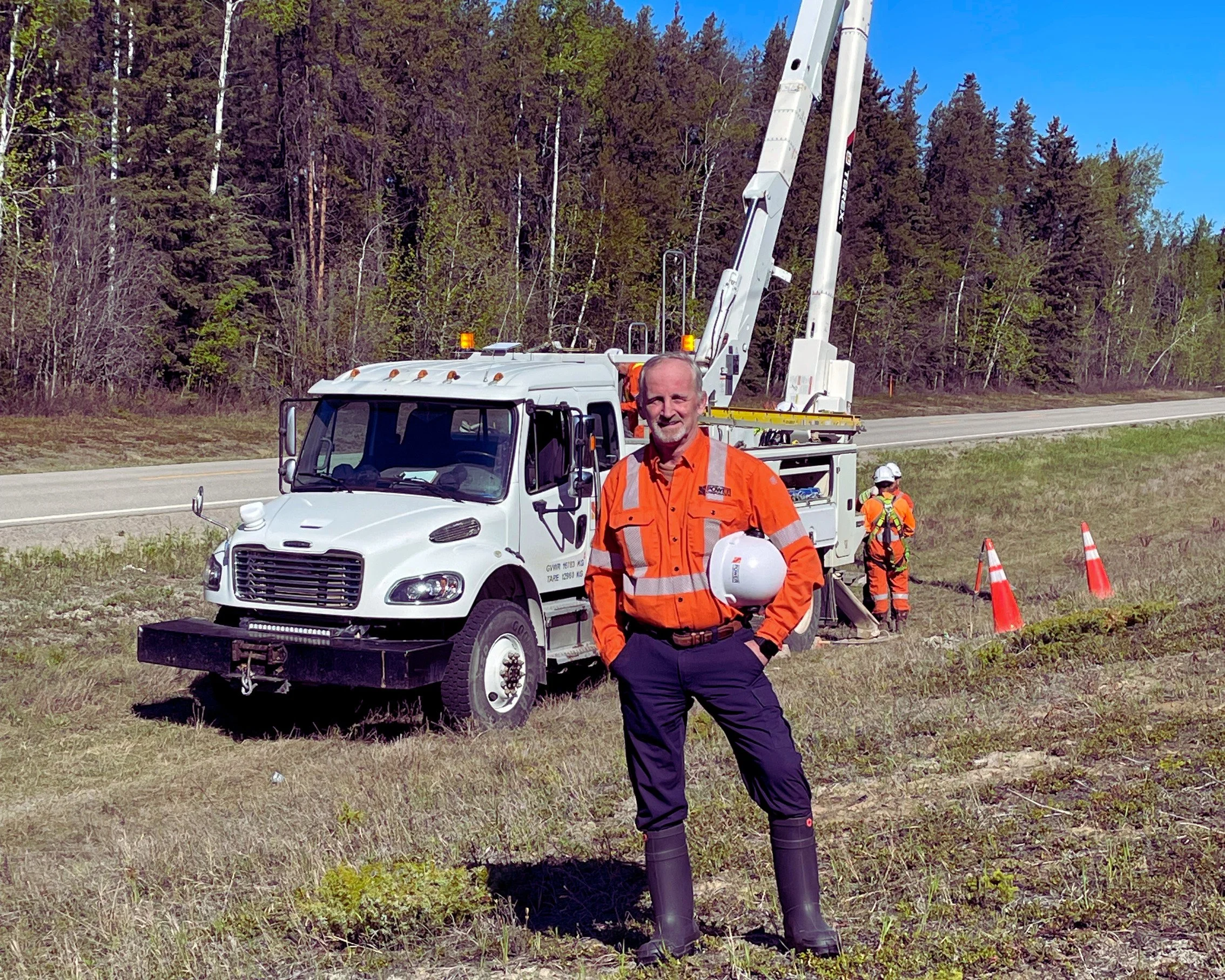
Lee Brenton has spent 41 years in the power industry keeping the lights on. Now he's focused on making sure the NWT grid can handle the biggest demand surge in a generation
By Lee Brenton, May 29, 2026
When someone asks what I do for a living, my first answer is always the same: I’m a power line technician.
I’m a director now, have been for a few years, but the line crew part comes out first. It always will.
What’s driven me every step of the way is the same thing it’s always been: Fix the problem. Get the power back on.
I’ve been in this industry 41 years – started in Newfoundland, moved north because the North got into my heart, and I haven’t looked back. That call of the North, the stories I’d grown up hearing sitting on my uncle’s knee, changed my life when I finally answered it.
I still remember the moment I decided to become a line tech. I was in a truck with my Dad, just out of high school, not sure what came next.
Then as they were going around a specific turn – I could still show you the exact spot – Dad pointed and suggested I could be on a line crew.
“They climb poles like that.” I grew up in the woods climbing trees, and so I thought that'd be kind of cool. Then he added you get to travel around and go through the bush.
That was it. Twenty-three years with Newfoundland Hydro, 15 years with Qulliq Energy in Cambridge Bay and Nunavut, a stretch with BC Hydro in Dawson Creek, and almost eight years now with NTPC.
The work has taken me from Newfoundland to the High Arctic to the NWT, and the thing that’s driven me every step of the way is the same thing it’s always been: Fix the problem. Get the power back on.
From one pole to a territory
When I was a line technician, I could fix one structure, one span at a time.
My scope was limited to what was in front of me.
When I moved into management, I realized I could fix things at the community level – not just a pole, but the whole community.
I’m responsible for getting the power from where it’s generated all the way to your toaster – across one of the most geographically extreme utility territories in the world.
Now, as director of transmission and distribution for NTPC, the scope has expanded again. I can fix things on a territorial level. I’m responsible for getting the power from where it’s generated all the way to your toaster – across one of the most geographically extreme utility territories in the world.
Now, I’m not going to pretend it’s that simple. But I will tell you this: if I can walk away and it’s better than when I came, that’s a good day.
The challenge right now is real and it’s well documented. Our grid infrastructure in parts is aging.
We operate isolated micro-grids across a vast territory, many of them diesel-dependent. The Snare and Taltson systems aren’t yet connected, which limits our ability to back each other up.
And we’ve seen more outages in recent years than we’d like. None of that is news to our customers, and it’s not something we’re going to talk around.
What I can tell you is what we’re doing about it.
Growth is coming
When COVID wound down, something shifted quickly.
Federal, territorial and municipal housing funding that had been bottled up for years started flowing into communities almost simultaneously.
Almost overnight, communities that needed five or six new connections a year were suddenly planning full subdivisions – dozens of new lots requiring power all at once. We’re currently working with Behchokǫ̀ on a subdivision development that, when complete, will roughly double the community’s power requirements.
That’s not a modest load increase – that’s a step change.
These aren’t speculative. They’re planned, they’re funded, and they’re coming.
Housing is only one driver. NORAD modernization will bring significant infrastructure to Inuvik and Yellowknife – new facilities, new industrial activity, new staffing, new businesses supplying all of it. And Pine Point mine is on the horizon.
These aren’t speculative. They’re planned, they’re funded, and they’re coming. The question isn’t whether the demand will arrive. The question is whether the grid is ready when it does.
I’ll give you a sense of what unexpected load growth looks like in practice. A couple of years ago, Délı̨nę came to us with plans to build a second ice surface and upgrade their ice plant to serve both facilities year-round.
Great community project – Délı̨nę, located on Great Bear Lake, is the birthplace of hockey, and you may have seen the outdoor game they hosted this year with NHL alumni on the lake ice.
But the power requirements for that new ice plant, at full load, were roughly equivalent to the entire existing load of the town. Normal load growth runs two to five per cent a year. This was double, essentially overnight.
We have to be ready for those moments.
How we plan for what’s coming
We have forecasting systems that track known and probable load growth – subdivisions, new community buildings, industrial projects – and feed that into financial and capacity planning models covering one, three and five-year windows.
We work in cross-functional groups with generation, planning and finance.
It’s better to build the capacity now than try to retrofit it later.
For the larger anticipated projects like NORAD and Pine Point, we’ve brought in specialized consultants and built working groups that model multiple scenarios with clear decision milestones.
Building generation capacity isn’t an overnight exercise – even smaller additions take two to three years minimum – so getting ahead of demand is the only responsible approach.
We’re also planning smarter at the connection level. New subdivisions are being designed for 200-amp service rather than the 60- or 100-amp standard of the past, because we know EV charging and evolving household energy needs are coming, whether we plan for them or not.
It’s better to build the capacity now than try to retrofit it later. As I like to say: you don’t want to be at the buffet and find out your Grade Eight track pants don’t fit anymore.
The people who make it work
None of this planning means anything without the teams who execute it. Our transmission and distribution people work across an environment that ranges from High Arctic harbour communities to heavily forested areas in Fort Smith and Fort Simpson, where you have trees big enough to take out a line on the other side of the road.
Our people know what’s at stake when they roll out.
These crews go out in blizzards, in ice storms, in conditions that most people wouldn’t choose to be outside in – and they do it because the power needs to come back on. Minus 40, small kids in the house, elders who need the heat – our people know what’s at stake when they roll out.
After more than four decades in this work, the feeling still hasn’t changed.
You restore power to a community, and sometimes grandma comes out with a loaf of bread and some homemade jam just to say thank you. You can’t put a dollar figure on that. You can’t manufacture it.
It’s the reason most of us got into this work and the reason we stay.
The Northwest Territories is about to go through a period of growth and transformation that hasn’t been seen here in a generation.
The grid needs to be ready for it. I’ve spent my career getting infrastructure ready for what’s next. This is the biggest “what’s next” I’ve seen, and I can tell you our teams are energized by it. We know what needs to be done, and we’re getting on with it.

Lee Brenton is Director, Transmission Distribution Operations for Northwest Territories Power Corporation.