
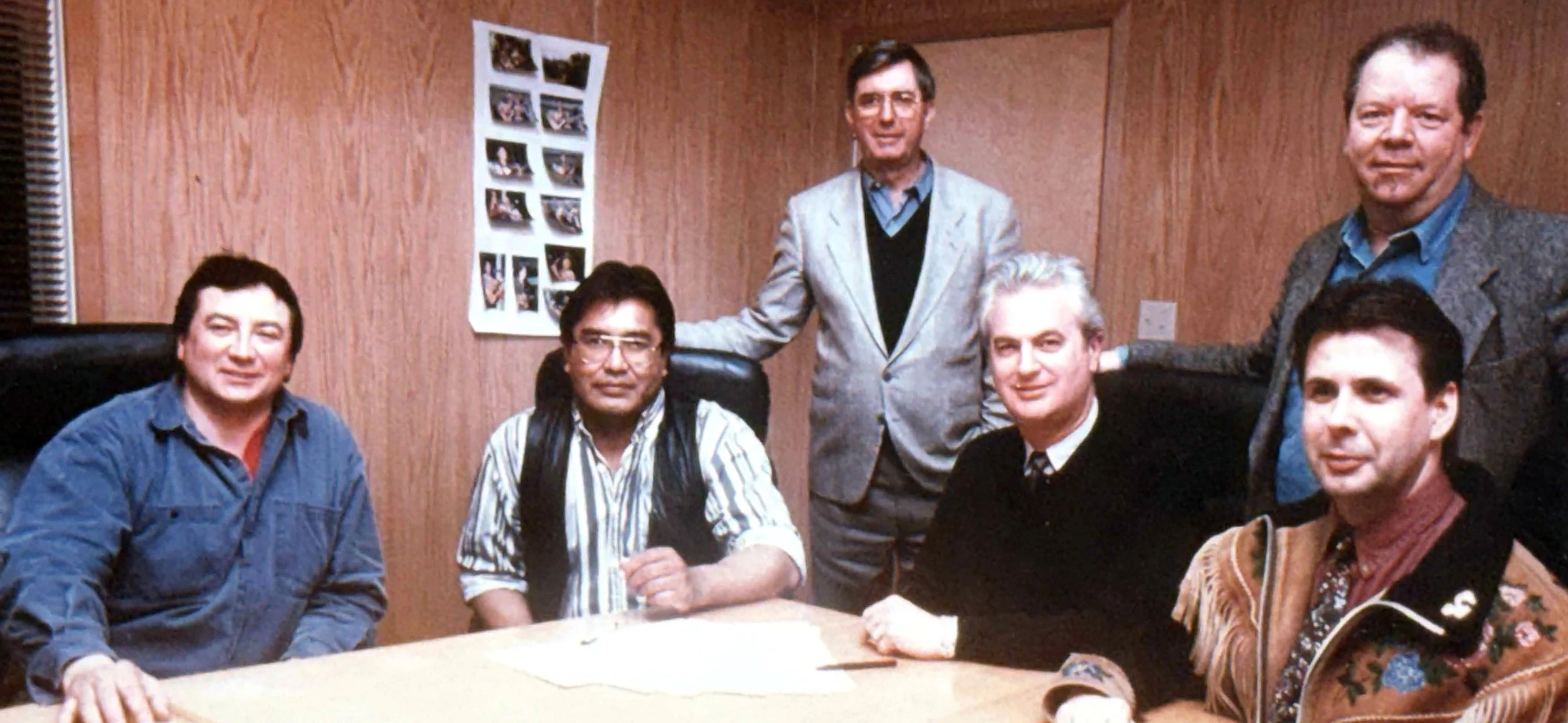
Robert Alexie Jr. and Willard Hagen of the Gwich’in Development Corporation, J.H. Robertson and A.J. Guthrie of NTPC, and witnesses Charles Dent, the minister responsible for NTPC, and David Krutko, MLA for Mackenzie Delta, at the ceremonial signing that created Aadrii, Fort McPherson, March 28, 1996.
Thirty years of equal partnership between NTPC and the Gwich’in Development Corporation show what shared ownership and practical collaboration can achieve – and offer lessons for communities exploring their energy future.
By John Williams
At Chief Julius School in Fort McPherson, some of the heat keeping the building warm comes from an engine doing another job: generating the community’s electricity.
That is a useful thing to do with heat that would otherwise be released into the air. Behind it is something equally worth recognizing: a 30-year partnership between NTPC and the Gwich’in Development Corporation.
Established in 1996, Aadrii brought the two organizations together as equal owners of a district heating business. Three decades later, that Indigenous partnership continues, along with the practical work of supplying heat to the school.
I’m proud of NTPC’s part in that work. It takes technical knowledge, people willing to solve problems and partners prepared to keep working together as circumstances change. Aadrii has required all three.
Equal ownership, shared responsibility
NTPC and the Gwich’in Development Corporation each own 50 per cent of Aadrii, with two representatives from each partner on its board. Both have a stake in the business and a voice in decisions about its operation and future.
It takes technical knowledge, people willing to solve problems and partners prepared to keep working together as circumstances change.
That matters. The partnership puts shared ownership and decision-making at the centre of an energy project serving a northern community.
From my side, as a mechanical engineer, the work involves understanding what equipment needs attention and what it will take to keep it useful. The partners then have to work through decisions about repairs and investment together.
Over 30 years, buildings change, equipment ages and new people take on leadership roles. Keeping a partnership working means making time for those conversations, listening to priorities and developing a shared understanding of what the system can deliver.
On a recent visit to Fort McPherson, I spent several hours with the community’s senior administrative officer discussing Aadrii. We talked through its continuing benefit to the school and what to do about older equipment affecting community planning. That kind of practical discussion is part of the job – helping build a brighter energy future for the people and places we serve.
A northern career and a northern home
I first became involved with Aadrii after joining NTPC as a field engineer in 2013. I came from northern Ontario looking for opportunities to develop as an engineer. NTPC certainly provided the challenge.
I lived in Inuvik for about seven years. I met my wife in the North and made good friends, including friends who later moved south. The job brought me here, and life gave me plenty of reasons to stay.
NTPC has been good to me. I later worked for the territorial government to gain experience on the management side, but I always had an interest in coming back. I returned as an asset manager, connecting the needs our operations teams identify in the field with decisions about repairs and capital investment.
One of the satisfying things about working on Aadrii is its purpose: getting more use from the fuel already being burned to generate electricity. That starts with heat that would otherwise go to waste.
Making more use of the fuel we burn
Aadrii captures heat from the power plant’s engines and exhaust. Heated fluid carries that energy through piping to a heat exchanger, which transfers it into the customer’s heating system while keeping the fluids separate.
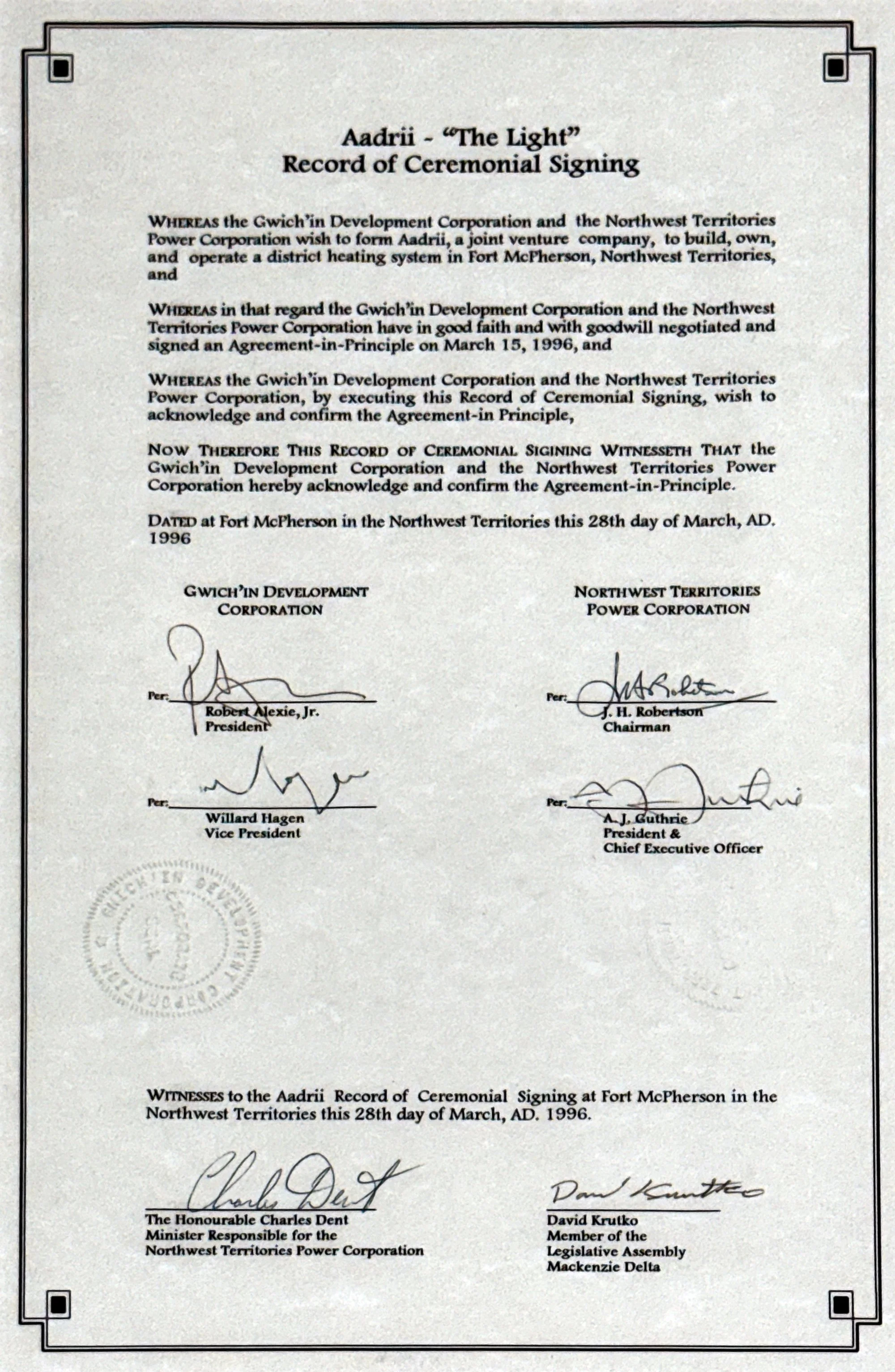
The Record of Ceremonial Signing that created Aadrii, signed at Fort McPherson on March 28, 1996.
Using that heat reduces the need to burn additional heating fuel and the associated greenhouse gas emissions. It is a practical way to get more benefit from fuel already being used to produce electricity.
Today, Aadrii helps heat Chief Julius School, reducing the need to burn additional heating fuel. Recovered heat works alongside the school’s own boilers, which provide additional heat during periods of high demand, particularly in very cold weather. Heat delivery currently serves the school; the water treatment plant and Tent & Canvas shop retain physical connections to the network.
Keeping Aadrii operating has taken sustained effort. After fire destroyed the Fort McPherson power plant in 2004, heat recovery was incorporated into the replacement plant. During my earlier years with NTPC, our work included repairs to piping supports and insulation, and replacement pumps, valves and controls.
Looking after Aadrii means continuing to care for the infrastructure as community needs and northern conditions change. Where permafrost movement has affected the inactive piping branch toward the water treatment plant, we are working with the community to determine the best approach. That ongoing attention is part of our commitment to the partnership.
Bring us your ideas
That experience is useful when communities consider their own energy projects. NTPC brings knowledge of northern power systems and what it takes to operate them over time. Communities bring their priorities and knowledge of what they want to achieve. Getting those perspectives together early gives a project a stronger starting point.
If your community is exploring an energy project, talk with us while the options are open, before committing to a supplier or a particular solution.
Bring us the goal: lower costs, less fuel use or cleaner energy. We can help examine how the options fit with the existing system and what they would require to operate and maintain.
With heat recovery, for example, building locations and heating needs matter. So does the future power supply: as renewables and batteries reduce engine running time, less recovered heat may be available. Those are useful questions to work through together at the beginning.
I’m proud that NTPC can bring decades of hands-on experience to those conversations. Aadrii’s anniversary also gives us reason to recognize our Gwich’in partner and the shared commitment behind this business. We welcome the opportunity to build relationships with communities considering what comes next.
John Williams is an asset manager for Energy North Operations at the Northwest Territories Power Corporation. A mechanical engineer, he first joined NTPC in 2013.